0.6.7
No more made-up limits: the dock shows what your agents cost instead. A merge ends in a small party, the bar dissolves into the notch when you drag it there, agents connect themselves to Wayari, and Settings holds your licence key.
release notes for wayari, the command inside the app, newest first. each line says what you will notice after you upgrade.
No more made-up limits: the dock shows what your agents cost instead. A merge ends in a small party, the bar dissolves into the notch when you drag it there, agents connect themselves to Wayari, and Settings holds your licence key.
The tabs say their words, several pull requests turn on a drum, every panel opens at one height, the notch stops jittering and rings a bell for what needs you, plans branch into lanes, and the graph is a network you can move through.
The graph is rebuilt so you can move through it. Drag the background or scroll with two fingers to pan, pinch to zoom toward where you point, or use + and - and fit in the corner. Drag any dot and the rest follow, then settle and stop. Hover a dot to light up what it touches; click it for a card that says what it is, who is on it, what it waits on and what waits on it, with its button; double-click to open it. Search for a job or a step, switch jobs, pull requests, plan steps and merged on and off, and the names never pile on top of each other.
A refused Build next says why and offers the next step. With no lead model chosen, the card offers a prompt to copy for your agent; a piece someone already took offers to see it. The plan is read again, so the card no longer offers a start that would be refused again.
The bar carries the six tabs and opens a panel under itself at its own width, the dock comes out of the notch, the notch shows who is working on what, jobs are written in one composer, and the graph is a network you can open things from.
The graph tab is a network you can use. Every job, pull request, plan and plan step is a dot in the colour of its state, joined by arrows from what has to happen first to what waits on it. What you can do next (merge a pull request, answer a question, build the next step) glows pink and sits above the graph as buttons. Hover a dot to see what it touches, click it to open it, drag and scroll to move around. It settles and then stops moving, so it costs nothing while you look.
Jobs are called by a short name. A job started from a sentence showed the first sixty characters of that sentence on every row; the dock now shows its first few words.
Build next and the start field no longer leave an empty job behind. On a machine where Wayari had not been told which model leads its agents, pressing start opened a job, marked its plan step taken, and then said nobody could start, with a command to type. The dock now checks first and says, in plain words, what to ask your agent; nothing opens until that is set.
No more cut-off cards in the open dock. Card shadows, the last row of a long list and the bottom of the plans map were clipped by the sheet's edge; they now sit inside it.
The notch is always there and opens on a hover and a click, the dock sums up what happened since yesterday, and its alerts are quiet.
The dock sums up what happened while you were away. At the top of now, one quiet line says since yesterday: 3 merged, 1 waiting on you, 1 stuck, $4.20 with the faces of who worked, and opens the whole recap: each pull request that merged with who built it and the screen it changed, what waits on you with its button, what got stuck with see why, the plans a merge moved and what it cost. When you have been away more than eight hours it reads from the moment you last closed the dock and says since you were last here. The expanded notch can show the same summary as one card.
The release where the dock becomes Wayari and a place you steer from. It connects your coding agent in one click, starts a job from a sentence or a dropped screenshot, answers an agent's question, shows where every job is, shows each changed screen before and after the merge, and lists your plans with the next step one press away. Option+Space brings it up from anywhere.

The dock has a design tab: mark up your app's screens and send the notes to the builder. It shows a job's latest pictures of each page at desktop and phone width, side by side, and you can pan, zoom, draw a box, draw freehand and leave comments on them. Send to the builder posts one message to the job, the same one wayari say posts, listing each mark with the screen and the pixels it points at, and the marked pictures saved where the agent can open them. Marks are kept per job until you send them. With no screens yet, the tab says how to get them and offers a prompt for your agent.
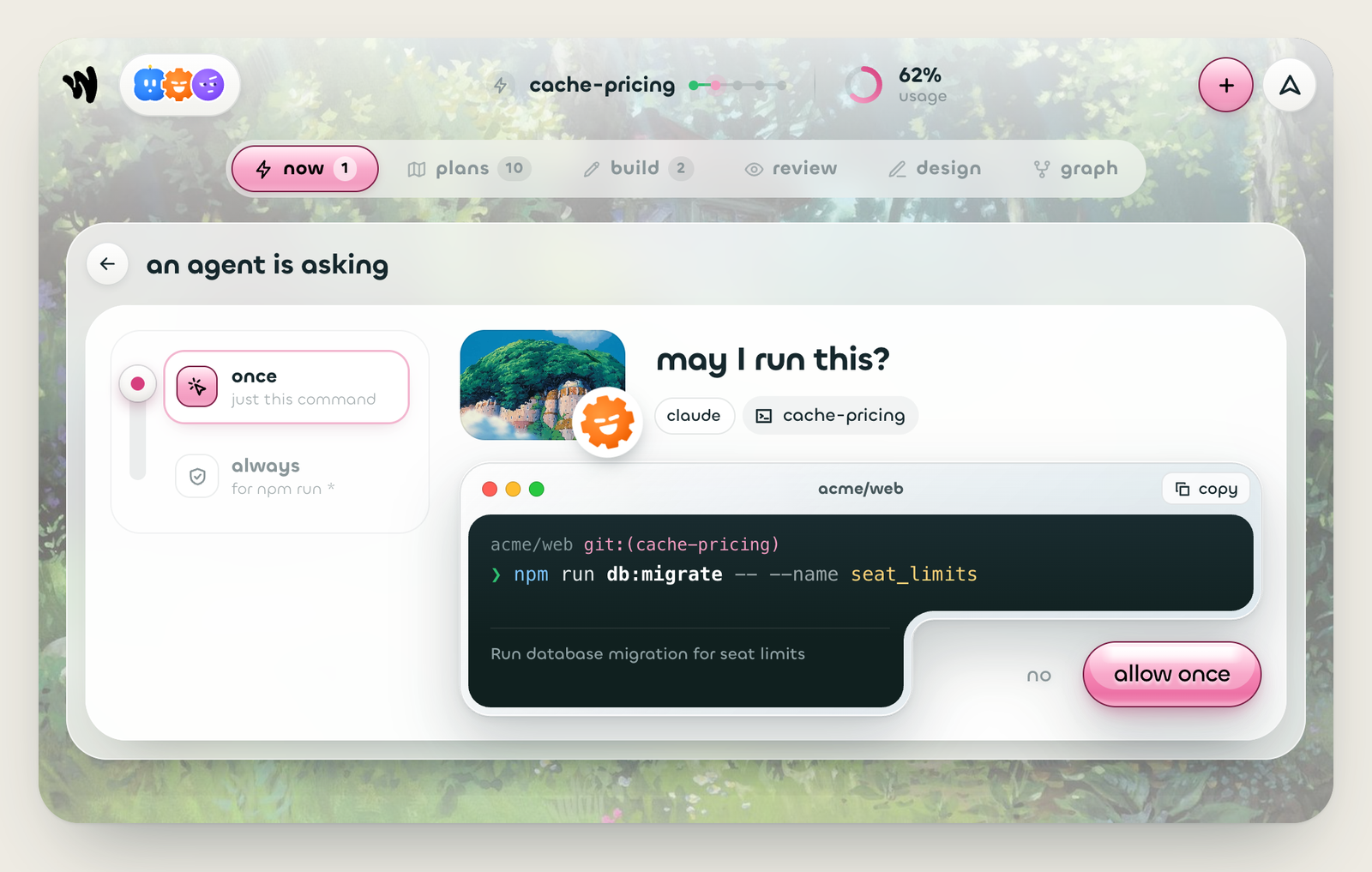
Answer your agents from the dock. When an agent stops to ask, the open dock shows the question as a sheet: may I run this?, the agent and the job, the exact command on a terminal card with a copy button, and a rail of how much to allow. Every rung is an option the agent's own screen offered: once, this session where the agent offers it, and always, with the agent's own scope under it. no and the pink button answer it as wayari answer would.
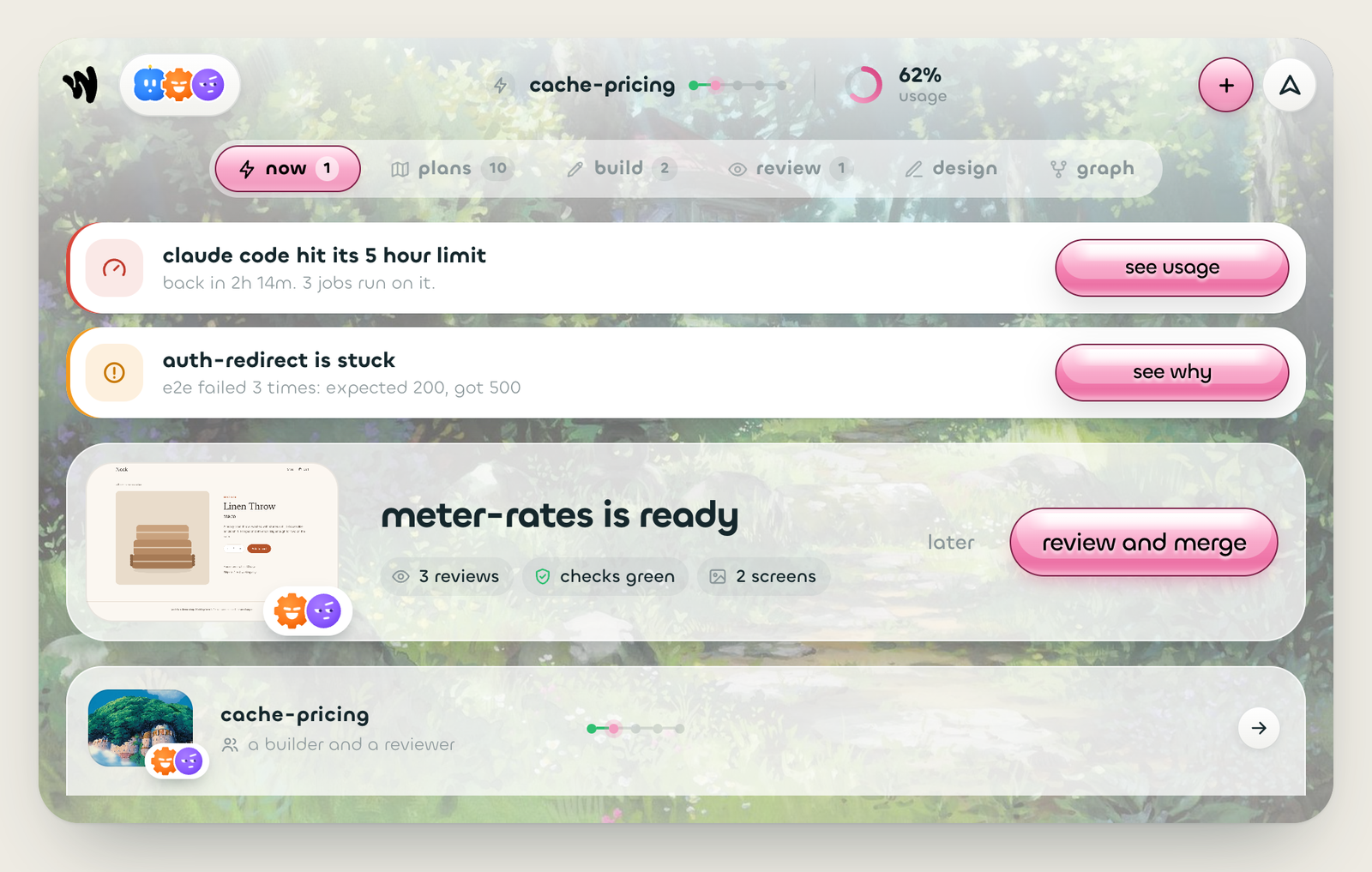
Opening the dock turns it into one sheet with six tabs: now, plans, build, review, design and graph, each with a count when there is something to count. now puts the one thing that needs you on a card (a pull request ready to merge, with who built it, its reviews and its changed screens, or a question an agent is waiting on) and every other job on a line that says what it is doing: building, 12m, 2 builders and a reviewer, or e2e failed twice in red with see why. Build shows who is on what now, review lists the pull requests waiting for you, and graph draws which job waits on which. The arrowhead at the top right, or Escape, closes it. The sheet rearranges itself when the window is narrow.
Wayari Dock is now called Wayari: the app, the download, the menus and About. It keeps its identity and its data, so an installed Wayari Dock updates to it and the wayari command it installed keeps working. Option+Space opens it from anywhere, with the sheet down.
The dock says how much of Claude Code's limits your agents used, and speaks up when one is hit. Tap the usage ring for Claude Code's 5 hour and weekly windows as bars, when each eases, and a "close" mark at your warning. The ring shows the tighter of the two, amber from the warning and red at the limit. With no plan picked it shows no percentage and asks which plan you pay for, sending what wayari plan sends; "warn me at 80%" turns the meter's warning on or off. Codex, Cursor and Gemini are listed as not measured yet, because nothing on the computer says their limits. A hit limit and a stuck job become alerts, above what waits on you and in the bar's waiting slot, each with one button: see usage, or see why, which unfolds the job's read.
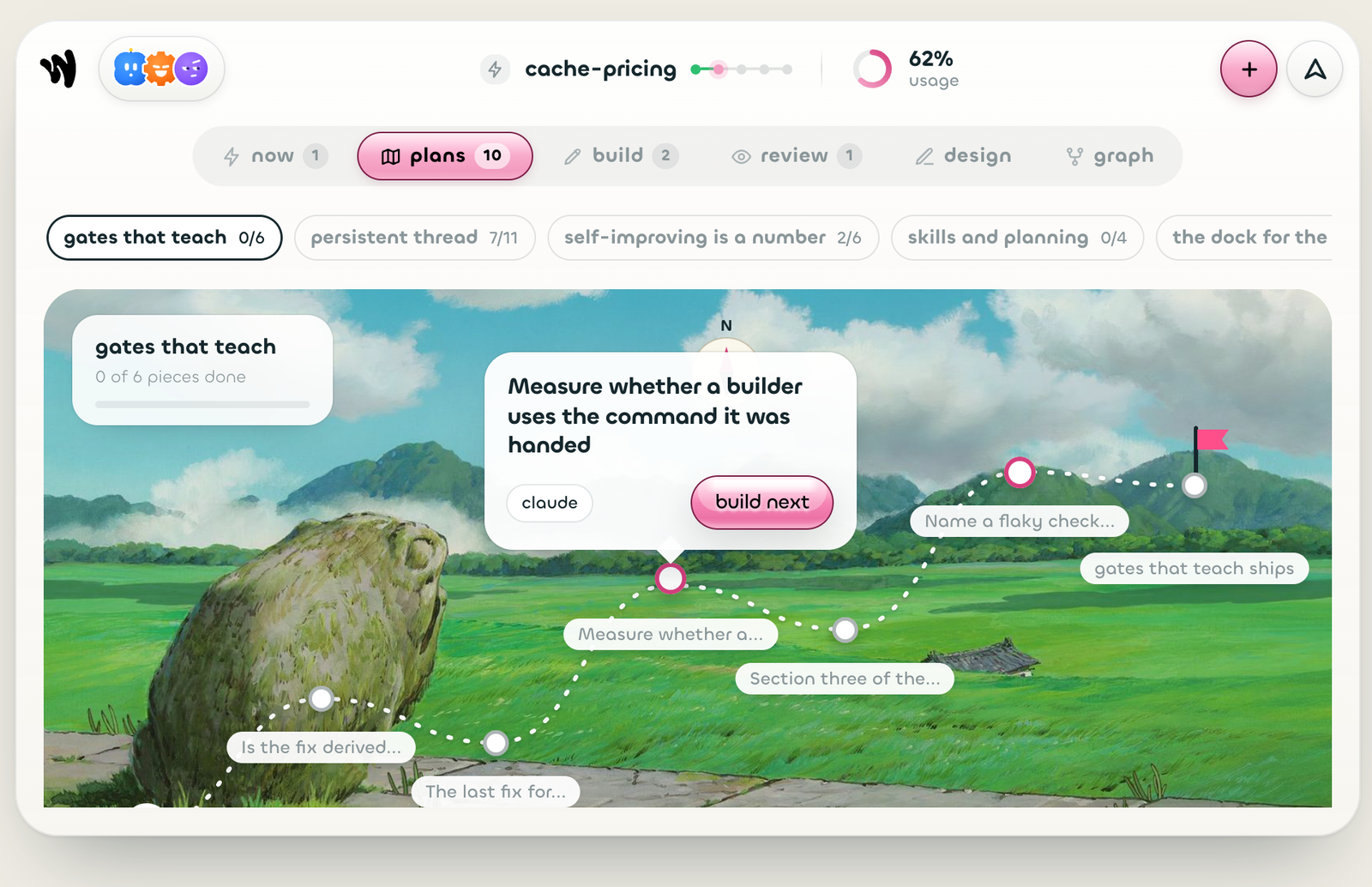
The dock shows where each piece of work is, what it changed on screen, and what comes next. Every row on the open sheet carries a slim track, Plan, Build, Checks, Review, Ready, lit where the work is, moving only while something runs and red where it is stuck. The merge sheet leads with a before and after picture of each changed screen that you drag across, named in plain words with how much of it changed. A Plans tab lists every plan with its progress and the next step, and Build next starts that step after asking, with no clock and no cap. wayari review's read over the socket now carries the changed screens as data (factory:review, screens).
Plans are a map. Each plan is a road across a painting: done pieces are green ticks, the piece being built wears the face of the agent on it, the pieces ahead wait on a dotted road, and a flag marks where the plan ends. Press a piece to see it; the next one builds with one press, after asking. Long plans turn back on themselves and scroll, and no two labels cover each other.
The command is licensed the way the app is. Every install is free until 28 September 2026. After that, three open days from first run, then $249 a year or $49 a month at https://wayari.com/pricing, with the first week free. wayari start, do, restart, replay and grant merge refuse when the licence does not cover new work, in one sentence that says what to do. Reading, kill, archive, ship and merge never refuse. Under --json and over MCP the refusal is action_required with reason licence.
wayari licence says where the licence stands in one sentence: trial until a date, active until a date on a plan, lapsed, or revoked, and what to do about it.
The dock connects your coding agent in one click. The first-run face finds Claude Code, Codex and Cursor on the computer, and Connect registers Wayari with each: Claude Code through its own claude mcp add at user scope, with the Wayari skill beside its others, Codex with one table added to ~/.codex/config.toml, and Cursor with one entry in ~/.cursor/mcp.json. Nothing the person wrote is changed, a file is backed up before its first edit, and a settings file that does not parse is left alone with the reason said. Three steps light from real state (connected, running, a first job) under one sentence to copy for the agent, and the face gives way to the bar once all three are lit. Connect another agent in the strip's menu brings it back.
wayari activate <key> verifies a key and saves it; wayari deactivate removes it to move it to another machine. The key is the app's key: pasted in either, it is one key.
Bare wayari, wayari status and wayari doctor say the terms, with wayari feedback beside them as the way to say what broke during the launch window.
The dock answers an agent's question. A permission prompt on an agent's screen shows its options as buttons in the sheet (Yes, Yes, and don't ask again for ..., No), and a press sends what wayari answer sends. A question an agent asked through wayari ask shows its own options, or a Reply field, and Dismiss tells the agent nobody answered. The row turns to a tick once answered.
The dock starts a job. The open sheet leads with "What should get built?". Return shows the repository it will run in, and Start sends what wayari start "<goal>" --repo <path> sends: no clock and no cap. Dropping text, a link or an image on the dock opens the sheet with the draft filled in; an image is kept under the data directory's drops/. A drop never starts anything.
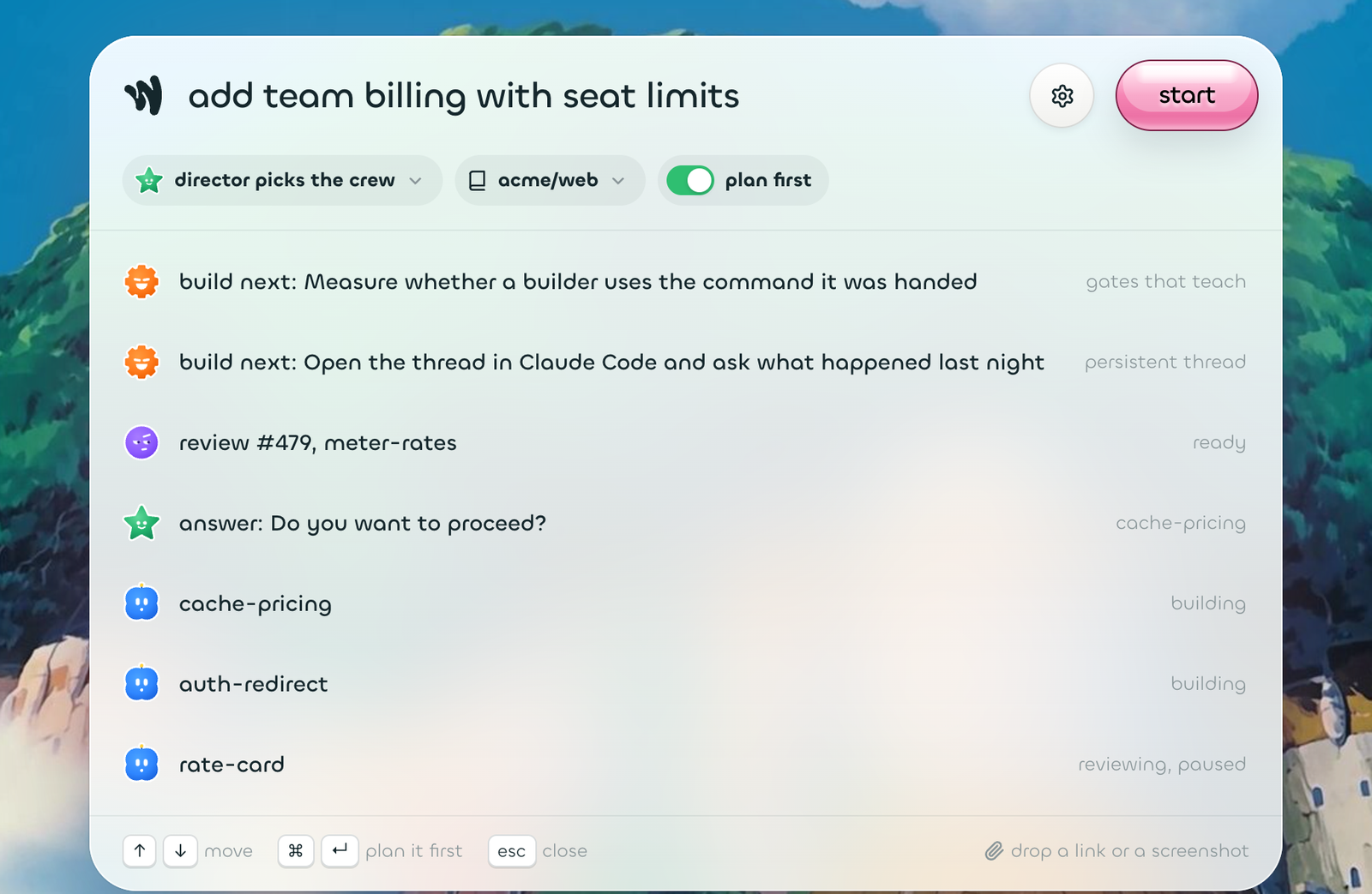
Option+Space opens a palette over whatever you are doing. Type a job and press Return; the chips under the field say who picks it up (the director, or a builder, designer or shipper), which repository, and whether to plan first, and Cmd+Return plans first whatever the chip says. Plan first is wayari start --size full, a role is --role. Under the field: the next step of a plan to build (it asks first), the pull request to review (the dock opens its merge sheet), and the questions waiting, answered from the palette. A dropped screenshot or link attaches to the job, and the clipboard does too once you turn on "attach my clipboard" in the palette's settings.
The first ten seconds. The W lands, the crew pops out of it and lines up, and one card says what to do: copy tell me what we can ship with wayari and paste it into your agent. Connect comes first while an agent does not know Wayari yet. After Copy the card listens, and says which agent started Wayari the moment it calls it, read off that agent's own transcript.
The install window has the painting, drag wayari into applications, a pink arrow to Applications and the crew along the bottom (npm run dock:dmg-background).
Codex's permission prompts are readable. Codex lights its chosen option with ›, which the option reader did not know, so every Codex picker read as having no options and the dock and wayari answer offered nothing to press.
The dock hides into the notch. The arrow on the dock folds it up into the Mac's camera notch, which keeps count: who is working and how far, a pull request ready with a review button, an agent's question with its answers, a little party when something merges, a limit hit and when it lifts, a job that is stuck. Hover over it and it drops open to the one thing that needs you and a small dock. On a display with no notch, and on Windows, it is a black pill at the top centre. The dock comes back where you left it, and it remembers which you chose.
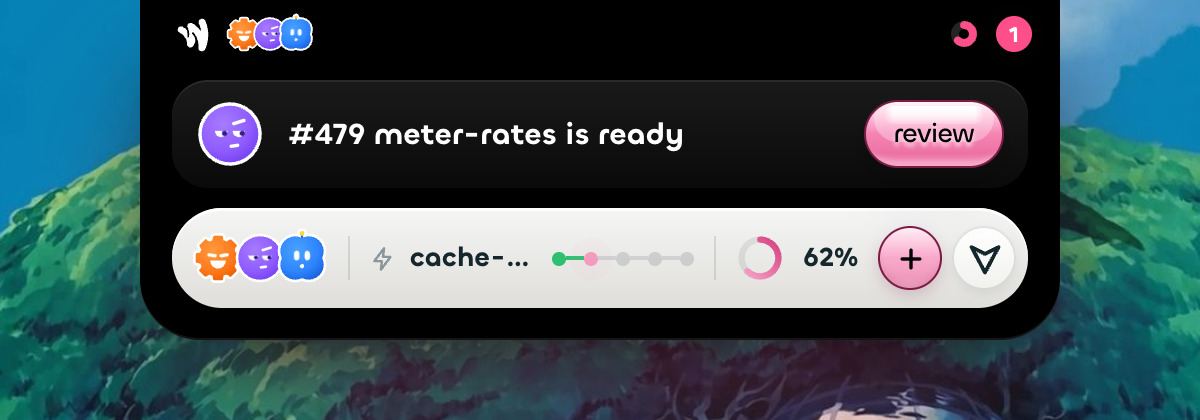
The resting dock is a glass bar: who is working, the job that is moving and where it is, how much of your usage is gone, and the one thing waiting on you.
Review and merge sit side by side at the right end. Review opens the pull request's read; once you have read it, merge turns pink, and a merge that lands sets the crew celebrating.
The bar has one arrow now, which folds the dock away. Press anywhere else on the bar to open it, or drag it to move it.
Opening grows the bar into a tall glass sheet in one smooth motion, and closing folds it back.
Drag the bar's sides, or the sheet's sides and bottom, to size them. The dock remembers each size on each display; double-click an edge, or pick Reset size from its menu, for the usual size.
When a usage limit is hit the ring turns red and the bar says when it comes back. Near the end of a free trial it says how long is left, and once the trial is over the crew sleeps until you buy.
Clicks on the dock's shadow go through to the window underneath.
Light and dark follow your system.
wayari start --file and --stdin take a brief up to 60,000 characters, as they always said. The daemon dropped where the goal came from, so a brief from a file over 8,000 characters was refused with the sentence telling you to use --file.
wayari replay runs an experiment again, not ordinary work. The daemon dropped the replay from the request, so a replay was briefed the atlas it was meant to withhold, and one that passed its gate opened a pull request. A replay whose arm cannot be recorded is now refused before a branch is cut.
The behaviour diff no longer runs wayari gate or wayari doctor. Each ship attempt used to run two extra full gates in the throwaway checkouts, outside the gate queue, and their checks outlived the capture's kill.
Your agent drives Wayari, and says so first. The MCP server's instructions and the wayari skill now open by telling an agent that the person does not operate Wayari: it runs the verbs itself and never ends a reply with a wayari command for the person to type. Only merging, arming a clock or a cap, and activating a key still wait for the person's word.
Licence keys starting WAYARI- verify. Every SKRIBBL- key still does.
The licence refresh and the billing page moved to wayari.com (/api/license, /buy/manage).
The gate runs its checks at the same time. Typecheck, orphans, wires, the build and the tests start together, so a gate lasts as long as its slowest check instead of the sum. Each check keeps its own column and its own captured output. A repository's own check that the gate does not know runs alone, after the rest, because it might write where another check reads.
The gate remembers what the trunk proved. After a green trunk gate, each test file is recorded with a hash of its text and of everything it imports. A channel's gate skips a selected test file whose hash matches and says so: "tests: 14 of 423 test files ran, 409 remembered green from the trunk at <sha>". A red trunk clears the record. Tests under scripts/ are never remembered, and a change to anything but a .ts file under src/ turns remembering off for that gate. The key includes the version of the node that runs the tests, asked through the check's own environment, so a record never carries across a change of node.
Typecheck starts warm, and a build nothing bundled changed is skipped. tsc runs with --incremental, its build info kept in the wayspace rather than the checkout, and the tests line says whether it started warm. The build reads unchanged when the diff touches nothing under src/ but tests, and no package.json, lockfile, tsconfig or vite config.
The release where Wayari reviews the code it wrote: a reviewer seat that is never the author, findings pinned to file and line, asked versus found, a behaviour diff, findings on the pull request, and a merge grant for the hours you sleep. The gate that checks all of it now runs in minutes rather than hours.
A reviewer reads every channel after its gate goes green. It is a read-only shift, staffed from outside the channel's authors, working at the sha the gate passed. It writes each finding with wayari finding <path>:<line> "<headline>" --scenario "..." --severity blocking|should-fix|note. wayari review prints them under What the reviewer found, or found nothing, or No review ran: and the reason. It never prints a verdict. A reviewer that goes silent is stopped once and never restarted, and the pull request still opens ready.
The reviewer runs on the lead's model, bounded by 30 minutes and $2 on API auth. A repository names its own in package.json as wayari.reviewer: { "agent", "model" }. A model the registry does not know is a staffing stop, never a quiet fall back.
An adversarial review, when the repository asks for one. A trunk whose package.json names wayari.review.proof asks the reviewer to prove a finding with a new test. Wayari reruns that test twice and prints it as proof only when it breaks the same way both times.
A fixed finding becomes a review rule. It is promoted to .claude/skills/on-review-<name>/SKILL.md, and the next reviewer on that repository runs it.
Findings land on the pull request as inline comments. blocking and should-fix findings with a line are posted as Wayari review: comments by the gh account that opened the pull request. A note stays in the body. A fixed finding gets one reply naming the commit, and its thread is resolved. "wayari": { "review": { "comments": false } } turns posting off. A gh failure is one line in the channel and never holds a ship.
Asked for, not found. Every sentence of the goal is checked against the diff, on the pull request and in wayari review. Only a path or a filename counts as checkable. Every other sentence is listed as needing a look. The section stays withheld until the diff is settled, so a builder cannot read which of its own claims are unanswered before it says done.
The behaviour diff: what changed that nobody had to read for. wayari review and the pull request compare the help text, the --json shapes, the declared checks, the skills and the MCP tools at the channel's base and at its head. wayari.surfaces in package.json narrows the five. A base that cannot be checked out prints cannot compare, never a clean diff.
The morning stack. wayari review --all is one page for every ready pull request, grouped by the map its ticket came from, in wayari graph's merge order.
The merge grant. wayari grant merge <channel>... --hours <n> (or --all) lets Wayari merge those channels for up to 8 hours. It merges one ready pull request a minute, and only when GitHub would, the gate is green at GitHub's head, a non-author reviewed that same sha, no blocking finding stands, nothing the goal named is missing, the behaviour diff is clean and every channel it stacks on has merged. A channel opened after the grant is never covered. Grants survive a daemon restart. wayari grant revoke ends one, and bare wayari grant is the morning page: merged, left for you, never reached.
npm run wires, the wire-check as a gate for this repository. It joins the IPC channels, the CLI verbs, their usage lines and the MCP tools, and prints one line per missing link naming both sides with file and line. It is declared in wayari.gates beside orphans, so another repository never meets it.
Skills served to agents. wayari skills lists the library and wayari skill <name> prints one whole, also as wayari_skills and wayari_skill over MCP, so a Codex or Gemini agent reads the same skills Claude does. A red check pulls on-red-<check> into the next builder's task file, with what fixed that check the last time. wayari promote <channel> --as <name> drafts a skill from what a channel taught.
The persistent thread and standing orders. wayari thread is one record per repository of what happened, and wayari note writes a line to it. wayari standing add "<order>" keeps what you say to every agent in .wayari/standing.md, and every shift and every MCP client receives it. The app has a Thread tab beside Findings.
An agent's first contact orients it. Bare wayari, wayari status and wayari_status open with a Here block per repository: its maps and their open frontier, open findings, who is on shift, and what to run next.
Maps. wayari map reads a plan written as a network of markdown questions under .wayari/maps/<name>/, with --ticket, --claim and --close. wayari start --map <name>/<stem> opens a channel on one ticket.
Findings from anyone. wayari finding <path> "<what you saw>" writes one from your own terminal, and refuses a path the trunk does not carry. wayari findings and the app's Findings tab show them channel by channel. wayari propose --from-findings groups them into one channel per check.
The page before the night. wayari propose writes one channel per goal, with seats, model, order and likely cost, and opens nothing until wayari propose --approve.
wayari atlas <path>: what is pinned to a path, which check reaches it, what breaks if you change it, who touched it last and what command works there.
Loops that stop. wayari loop start, wayari loop pass and wayari loops record a hunt pass by pass and stop it after two passes in a row with nothing new. A hunt is a channel whose output is findings.
wayari replay <channel> --without atlas re-runs a finished channel's goal from its own base with the atlas withheld, and --reviewer <agent>/<model> swaps the reviewer instead. Neither opens a pull request. npm run evidence --arm <field> groups the routing rows by any field, so each arm is readable beside the other.
wayari start --after <channel> waits for the blocker's pull request. A follower whose blocker has not opened one is armed and left unstaffed, and starts itself when it does.
The gate runs in minutes. A change to docs, skills or .wayari/ records typecheck, build and tests as unchanged and still runs every declared check. A code change runs only the test files it can reach, and the tests line says how many: "214 of 4,166 test files ran, reached from 6 changed paths".
The whole suite runs once on the trunk after every merge. A red trunk says trunk gate failed in that channel and trunk is red in wayari status and first in wayari review --all, until the next green.
Two gates run at once when the machine is quiet, never three. Behind a running gate, wayari ship answers queued at once and says which gate it waits for.
A stack gates once. A follower's green gate at a sha carrying all of its blocker's commits proves the blocker, whose pull request is marked ready. Merge order is unchanged.
A single test that hangs fails by name after fifteen minutes (WAYARI_TEST_TIMEOUT_MS to change it).
A clock is said, never defaulted. wayari start and wayari do without --hours run until the work is done.
wayari say to a member in the middle of a command is queued for its next prompt instead of refused.
wayari status shows live channels only, counts the archived ones on its last line, and shows them with --all.
A member's role reaches its shift through a section of the task file.
grant joins serve, attach and stop as verbs that are never MCP tools. wayari grant refuses inside an agent's session. No agent's word is enough for eight hours of merges nobody watches.
Not done: GitHub Actions never ran on this repository during this release. A billing block stops every job before it starts, so every merge stood on the factory's own gate. wayari merge --on-local-gate records that, names the checks that never ran, and never gets past a check that ran and failed.
The daemon ended sessions it did not own. The test suite, run inside a shift, ran wayari clean against the machine's one tmux server and killed live shifts. The suite runs on its own tmux server now. The daemon reaps a shift session nobody owns and never touches a session whose channel it does not know.
Eight fixes from a stranger's first run of the published command (#199):
wayari status --json through a pipe was cut at 65,536 bytes.
--file was held to the 8,000-character cap for typed goals. A file or a pipe carries 60,000.
The long-goal refusal said "leave the rest in the issue". It says to use --file.
wayari status printed every archived channel.
Five skill docs said .skribbl/ where they meant .wayari/.
A finished builder was recorded as three stalls, because nothing durable told it how to finish. The task file now says "run wayari done. Committing is not finishing".
wayari ship failed on a fresh checkout of a workspace repository, which linked only the root node_modules.
wayari review printed the brief twice.
A ship whose caller died held the channel. Every later ship refused until wayari stop. A latch older than any gate could run is taken again.
A killed channel could not be restarted once its worktree was swept. A member's surviving branch is checked out, commits and all, reported as reused, and never deleted by a rollback.
A channel that ran out of clock while queued at the gate was archived minutes before its gate passed. The out-of-clock verdict waits for the gate. Running out of money still lands at once.
A stuck wayari stop wedged the owner lock.
wayari ship could not find the checkout wayari take made. It also refused a person's ship after the clock ran out, and ran a queued ship for a channel already archived or merged.
A finding's headline could be npm's banner or the echoed command line.
A tool line in wayari open showed the cd, not the command.
wayari status --json carried a whole failure block. It keeps the first line.
The graph kept a merged pull request as open.
The findings read missed a shipped channel's gates.
wayari start --after refused a blocker that ran out of clock and shipped.
A replay's task named the arm it was testing. It does not now.
The release that makes the command installable. Everything below had been on the trunk for a day without reaching anybody, and 0.3.1 is the build that cannot install at all on a machine without a C++ toolchain.
npm i -g wayari on a machine with no C++ toolchain. It did not install at all. node-pty 1.1.0 ships prebuilt binaries for macOS and Windows and not for Linux, so npm compiled from source, and node-gyp needs Python and a compiler. Every container image and every minimal Linux box failed with a wall of gyp output, nothing installed and wayari not on PATH. macOS hides this because Xcode's command line tools provide the compiler, which is why it went unnoticed.
node-pty is now pinned to 1.2.0-beta.15, which carries prebuilt binaries for Linux on x64 and arm64 as well as macOS and Windows. On a Debian image with no python3, make or g++ the install takes one second, compiles nothing, and puts a process on a pty. The pin is exact rather than a caret: a beta can drop a prebuild as easily as it added one, and the build refuses to run if the range grows an operator.
A gate that could never pass on a repository that is not npm-shaped. The refusal for a repo with no package.json told people to write wayari.json with one check in it. The gate runs three, and a check the gate names and the repository does not declare fails closed, correctly and forever. The refusal now names every check the gate will run and its example declares all of them. A Python repository and a Go module both go green this way, which had never been tried before today.
gh on a machine with no browser. The doctor told a signed-out machine to run gh auth login and never mentioned GH_TOKEN, which is the only path on a headless box or a cloud container. gh auth status already accepted a token, so the check was right and only the sentence was wrong.
The doctor could not tell you whether this machine can start an agent at all. It now asks two questions it never asked: whether node-pty can put a process on a pty, and whether an agent CLI that is on your PATH is actually signed in. A machine with claude installed and no credential used to pass every row and then hand a builder a login prompt, which on a headless or cloud box is the normal state rather than an edge case. The sign-in row says "cannot tell" rather than guessing when the credential lives somewhere it cannot look, because a red row you cannot argue with is worse than an honest unknown.
wayari doctor --fix runs the fixes that need nobody's password and nobody's browser, prints what it is about to do first, and refuses anything interactive, anything needing sudo, a reinstall of itself and the choice of lead model, naming the command for each so the refusal hands you something. Bare wayari doctor still changes nothing.
A refused ship said only that the gate did not pass. It names the check that failed now. The failing check and its output were already in hand when it said nothing.
The read emptied every checkbox when one check failed, so it told you typecheck had failed on a run where only the tests did. Each box is drawn from its own check now.
A channel was cut from whatever your local trunk happened to be, which in a checkout that never visits main is arbitrarily old. It is cut from the trunk as the remote has it, unless your local one is ahead, and the answer says how far behind the local one was. A rebased branch can also be shipped again, which it could not before.
A pull request that was already open was reported as "not shipped", after the work had been assembled, gated and pushed. It is reused, and says it was.
A night did not survive the machine it ran on. Every commit lived on one disk until the channel shipped, so a cloud box torn down at 04:00 took the whole night. A member's branch now reaches the remote while the shift is still running, and a shift that ends holding uncommitted work saves it as a labelled checkpoint rather than only mentioning it.
An agent running a long command was announced as waiting on a question. Two minutes into a test run, with the verb that answers a question nobody asked. An open tool call now silences that, and never silences a real permission prompt or an open wayari ask.
Task files collided between channels. Every channel staffing builder-1 committed the same path, so the second to merge conflicted with the first. They are keyed by channel now, and a worktree made before this change still finds its task.
A member's worktree could commit a node_modules symlink, which landed on a branch as an absolute path to one machine, because node_modules/ in a .gitignore does not match a symlink of that name.
The codebase map produced nothing for most repositories. It scanned src only and read TypeScript only, so a Python service or a Go module got no pages and the context a builder received was silently empty. It reads any layout and many languages now; the import graph is still TypeScript only and says so.
A long brief passed as a shell argument was eaten by the shell. --file and --stdin on do, say and ask carry it whole.
Alpine and other musl distributions now need one flag. npm i -g wayari --build-from-source, with python3, make and a C++ compiler present. The prebuilt Linux binaries are built against glibc and will not load under musl, and node-pty's installer checks only that a prebuild directory exists rather than that its binary opens, so it takes the wrong one. Before this release a musl box with a compiler worked without the flag. It is a real regression for those machines and the trade is deliberate: every glibc Linux machine goes from failing outright to working, and musl goes from working to working with a flag that the install now names.
npm hides what the install says. foreground-scripts defaults to false, so nothing a postinstall prints reaches the person on a plain npm i -g wayari. The introduction to the coding agents on the machine still happens; only the words are lost. The next step is on wayari.com and in this package's README for that reason, and wayari doctor is the surface that reports a problem.
the first release with written notes.
download wayari and the command is inside it. it is free to try, with no card and no signup.